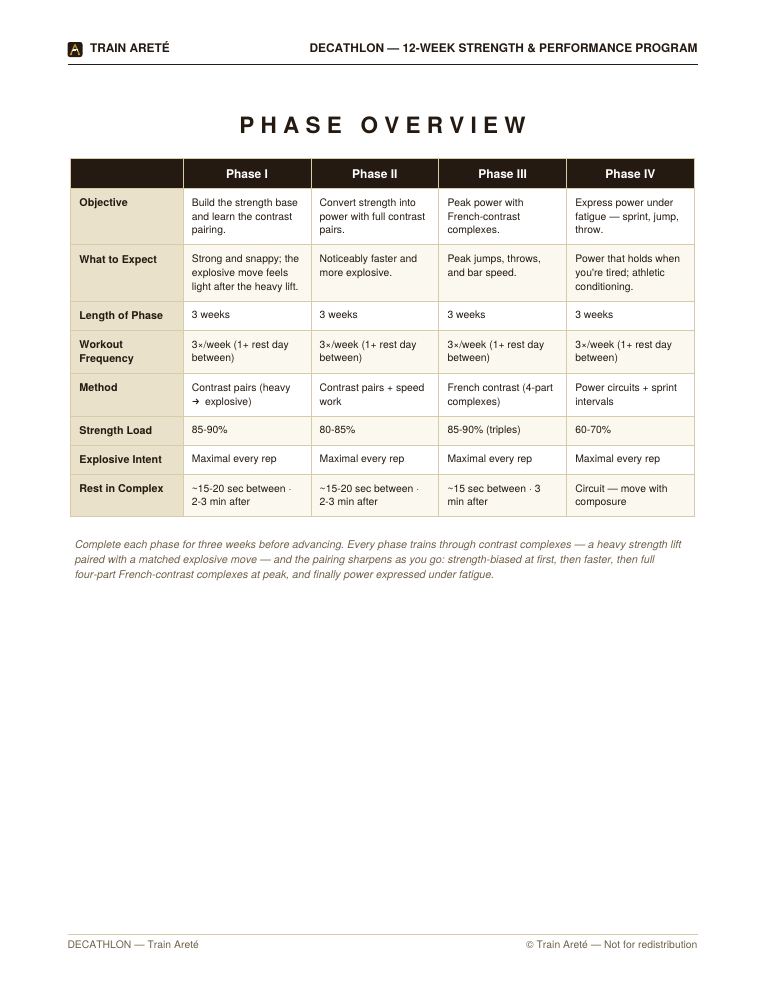
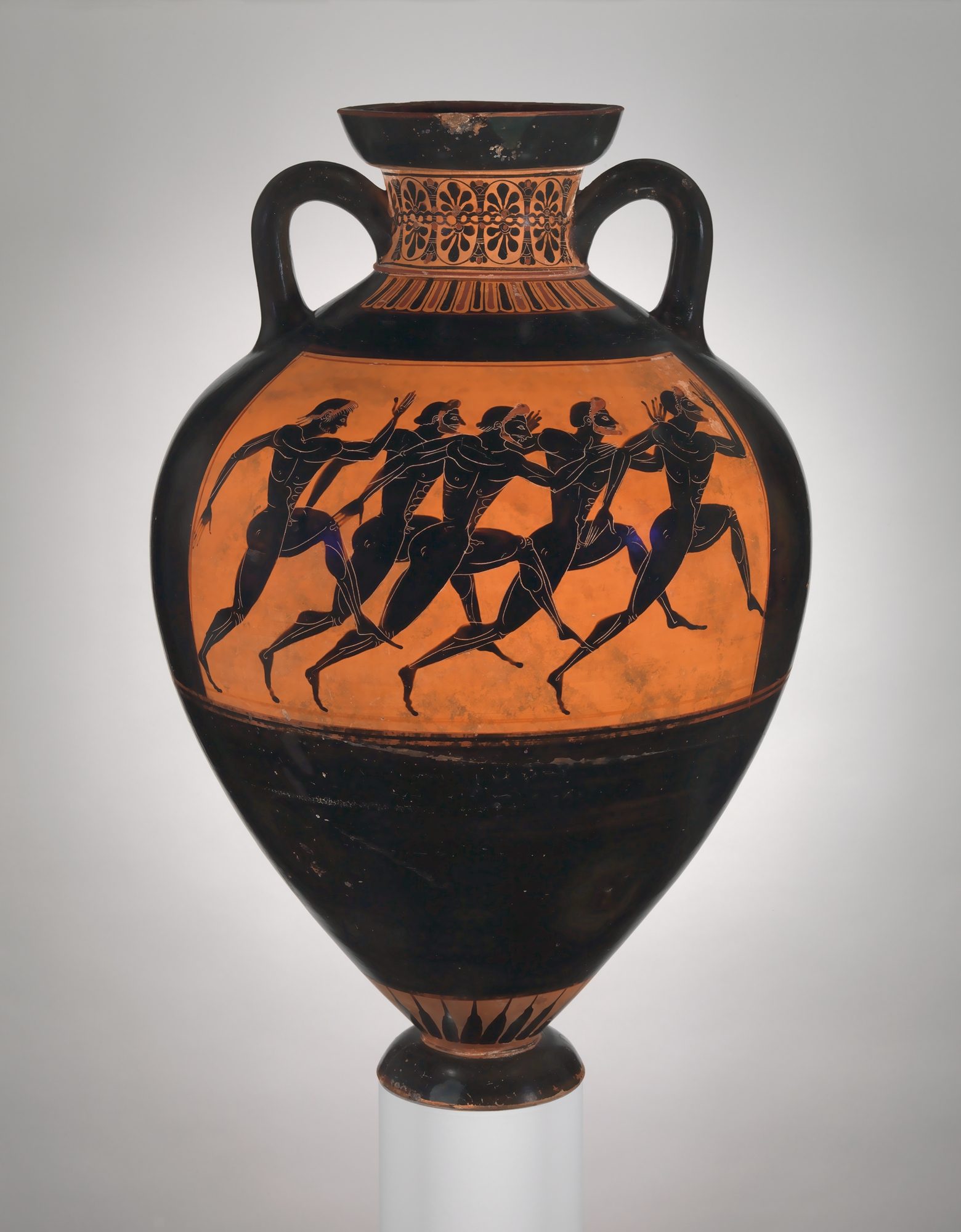
Panathenaic prize amphora, The Met
4 PHASES · CONTRAST TRAINING · GYM REQUIRED

Decathlon

Named for the ten-event contest that crowns the most complete athlete in sport.

Lift heavy, then move fast. Decathlon pairs every heavy lift with an explosive jump or throw — so your strength becomes the kind of power you can actually use.

11-12 weeks (Phase IV runs 2-3)
Duration
3x/week (1+ rest day between)
Frequency
Gym required
Equipment
Power & speed
Focus
The myth behind the name

Ten contests, one complete athlete

The word is Greek — déka athla, "ten contests." At the ancient Games, no athlete was more admired than the pentathlete, whom Aristotle called the most beautiful of athletes: built for every event rather than perfect at one. The modern decathlon carries that ideal to ten.

This program chases completeness the same way — twelve weeks of turning raw strength into real, usable power, so it shows up whenever you jump, throw, sprint, or drive off the line.

The approach

How the program works

Decathlon is built around one simple, powerful idea: lift heavy, then move fast. In every pairing you do a heavy strength exercise, then — while your muscles are still switched on from that heavy set — you immediately do an explosive move like a jump or a throw. The heavy lift wakes your muscles up, so the jump or throw comes out faster and more forceful than it would on its own.

Do that for twelve weeks and your raw strength turns into real athletic power — the kind you can use to jump higher, throw farther, and move quicker. The program builds in four phases: you start with simple pairs, add speed, stack the moves into longer sequences at the peak, then learn to keep that power going when you're tired. Real sprint, jump, and throw work is built in throughout, and you train three full workouts a week with a rest day between them.

You'll always know it's working: on Day 1 of every phase you test a standing broad jump — best of three — and log the distance. As your strength turns into speed over the twelve weeks, that number climbs, giving you one simple, honest measure of your progress.

Every exercise also comes with ready-made alternatives — barbell, dumbbell, kettlebell, or athletic-ball versions — so you can fit the program to the equipment you have. If you do swap, keep barbell squats and deadlifts as your foundation, and always keep the explosive half of each pairing — that's where the power comes from. The days between are for recovery — rest, or use them for an optional catalyst session (see the final page).

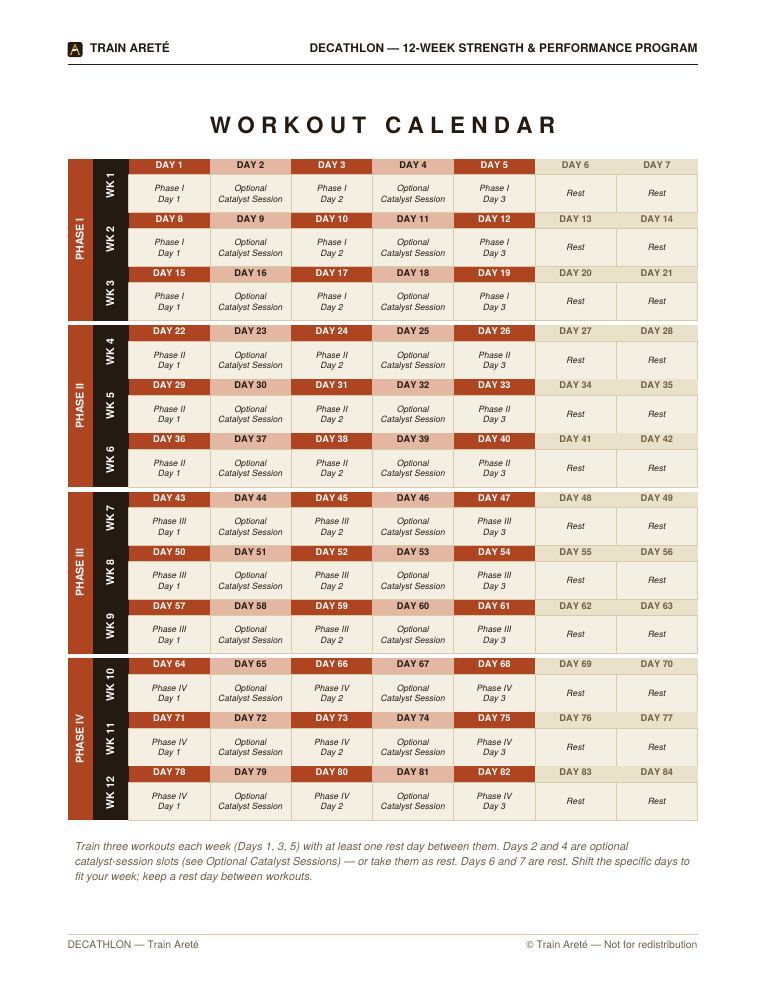
Train three workouts each week (Days 1, 3, 5) with at least one rest day between them. Days 2 and 4 are optional catalyst-session slots (see Optional Catalyst Sessions) — or take them as rest. Days 6 and 7 are rest. Shift the specific days to fit your week; keep a rest day between workouts.
The structure

What's inside

Four phases over twelve weeks. Each one sharpens the lift-then-explode pairing — from simple pairs, to faster combinations, to your most explosive weeks, to power that holds up when you're tired.

PHASE I
Maximal Strength Base
Build the heavy strength, and learn the lift-then-jump pairing.
Weeks 1-3
PHASE II
Strength-Power Contrast
Turn that strength into speed with faster pairings.
Weeks 4-6
PHASE III
Peak Power
Stack the moves into longer sequences — your most explosive weeks.
Weeks 7-9
PHASE IV
Power Endurance
Keep the power going when you're tired — power circuits and sprints.
Weeks 10-12

Every program ships as a print-ready PDF with full exercise tables and a week-by-week calendar.

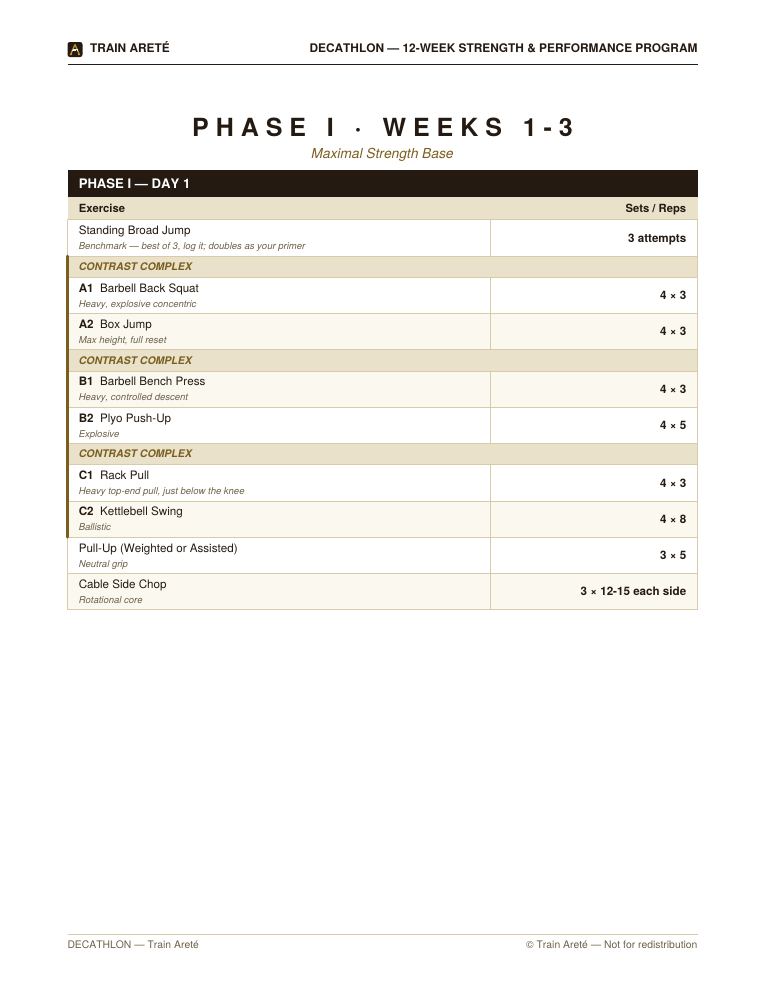
Sample page — phase overview Sample page — workout calendar Sample page — workout table

Actual pages from the book — tap any to enlarge.

Is this your path?

Who it's for

Nearly every Train Areté program reserves an optional catalyst-session slot in its weekly calendar — specialization add-ons from the add-on library are built to drop straight into it. If your program has no catalyst day, the specialization add-ons carry a Micro-Catalyst page that doses the same work in minutes.

Decathlon

$69 one-time